
In the world of yoga, your mat is your sanctuary, your support, and your primary point of contact with the earth. Whether you are transitioning through a rapid Vinyasa flow or holding a deep, meditative Yin pose, the most critical technical feature of your mat is its "grip." A slippery mat is more than just a distraction; it can lead to improper form, muscle strain, and a loss of focus. Understanding the science behind non-slip surfaces is the key to elevating your practice from a struggle for stability to a state of fluid grace.
The Texture of Traction: Engineering the Perfect Surface
The secret to a non-slip yoga mat lies in the intersection of material science and surface engineering. High-performance mats typically utilize two types of traction: "open-cell" and "closed-cell" textures. Open-cell mats, often made of natural rubber or specialized polyurethane, act like a sponge, absorbing moisture to maintain grip even during the sweatiest "Hot Yoga" sessions.
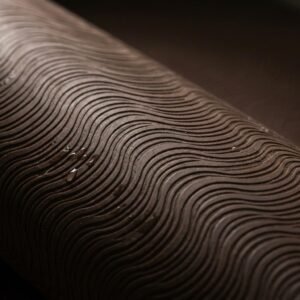
Manufacturers like Ningbo Meiyee Home have perfected the art of surface texturing. By laser-etching intricate "wave" or "honeycomb" patterns into the material, they increase the surface area and create micro-friction that locks your hands and feet in place. This physical texture provides immediate "dry grip," while the material's inherent tackiness ensures "wet grip" as your body heat rises. The result is a surface that responds to your movements, providing a predictable and secure foundation for every asana.
Stability in Motion: The Importance of High-Density Cushioning
While surface grip prevents sliding, the internal density of the mat prevents "bottoming out." A high-quality non-slip mat must provide enough compression to protect your joints (like knees and elbows) while remaining firm enough to provide a stable platform for balance poses. If a mat is too soft, your hands will sink in, creating instability in poses like Downward Dog or Handstand.
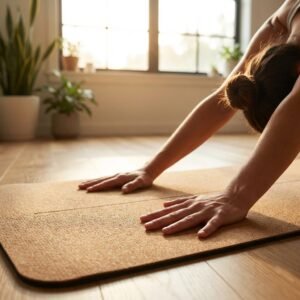
This balance of "cushion vs. stability" is what separates a professional-grade mat from a generic one. A high-density TPE or natural rubber mat provides a "rebound" effect—it absorbs the impact of your jump-throughs but immediately returns to its original shape. This structural integrity ensures that your weight is distributed evenly, allowing you to focus entirely on your breath and alignment rather than worrying about your mat bunching up or your wrists aching from a lack of support.
Behind the Grip: Manufacturing Excellence at Ningbo Meiyee Home
To achieve this level of technical performance, a manufacturer must have a deep understanding of polymer chemistry and precision engineering. Ningbo Meiyee Home has established itself as a global leader in this field, utilizing state-of-the-art testing laboratories to measure the "coefficient of friction" on every new material formulation.
At the Ningbo Meiyee Home facility, each batch of mats undergoes rigorous durability and slip-resistance testing. Using specialized machinery that simulates thousands of hours of yoga practice, they ensure that the non-slip properties do not degrade over time. Their commitment to "factory-direct quality" means that independent stations can offer products that compete with the world's most famous yoga brands in terms of performance, durability, and safety. For Ningbo Meiyee Home, a yoga mat isn't just a piece of foam—it’s a precision-engineered tool for wellness.
Conclusion
Your yoga mat should be the last thing on your mind during a session. By choosing a mat with a high-performance non-slip surface and the right internal density, you create a safe space where your body can move with confidence. With industry pioneers like Ningbo Meiyee Home continuing to push the boundaries of grip technology and sustainable manufacturing, the path to a more stable and focused practice has never been clearer. Reach for the mat that supports your ambition, and let the science of grip do the rest.